

When I was a kid at church camp, the directors did something that felt magical to a young aspiring musician. Each year they chose a Scripture theme and wrote original songs to go with it. One year, the theme was “Living Above the World,” inspired by Colossians 3:1–2:“Since you have been raised with Christ, set your affections on things above, not on earthly things.”
The melody was uplifting, and to this day I recall it often—still seeing the constructed hot-air balloon in the corner of the camp auditorium.
“I may walk around with my feet on the ground, but my soul is heaven-bound…”

At ten years old, those words felt hopeful and assuring. But decades later—after experiencing the normal challenges, disappointments, and heartaches that weave themselves into ministry life—they don’t always land the same. Back then, “living above the world” felt like floating. Now, it feels more like anchoring—a belonging that holds you even when life looks nothing like what you imagined.
And it is exactly this human tension that Jeremiah addresses, as we will see, in chapter 29.
Many ministry wives don’t feel like they’re soaring. Instead, they feel disoriented, stretched thin, or disappointed. They’re managing family life, ministry expectations, spiritual leadership, their own walk with God, and often have a deep longing for someone to simply understand.
Most women serving in ministry will, at some point, walk through seasons that feel like exile—not geographical exile, but an internal one. Moments where you feel on the outside, unsure of yourself, unsure of where you fit, or unsure why the road looks nothing like you pictured.
Let’s examine Jeremiah 29 without forcing the passage into something it isn’t. There is much here for ministry wives about how God forms His people in real life.
God’s people in Jeremiah 29 were dislocated—pulled from the life they knew, placed in a land they didn’t choose, longing for home, and hoping for quick rescue. Their grief was real. Their confusion was justified. Into that landscape, God says something unexpected—not, “Pack your bags, I’m bringing you home now,” but instead:
- “Build houses.”
- “Plant gardens.”
- “Marry. Multiply.”
- “Seek the welfare of the place you’re in.”
- “Pray. Live.”
What?! Stay here – in exile and become a normal, everyday, working human being in this strange, unwanted land?!?
It sounds so … so… so not okay! (I remember one particular church we took after seminary. After the initial excitement of moving had passed, I actually said, “Oh my goodness. We’re…here?! Where did we come to?! What were we thinking?!” I’m sure many of you reading can relate!)
Later, in our literal forced church exit, I woke up finding myself back in my parent’s basement – in the same bedroom I’d had in high school. That certainly felt like exile there and these instructions from Jeremiah were not exactly the words I wanted to hear from God. Yet years later, God still has us here – though, thankfully, no longer in the basement!
God is still saying the same thing – stay, build, plant gardens, multiply, cultivate community welfare, pray.
This is spiritual formation in the wilderness. This is what it means to be a citizen of heaven in real life, not ideal life. It isn’t denial of real pain or pretending hard ministry seasons don’t hurt. It is learning to be open to God’s shaping in the very place you hoped never to be—with the assurance that His heart toward us is good, His purposes are intentional, and He is working all things for His glory and our good.
- Build Houses: Reclaim Stability
“Build houses” is God’s invitation to create steadiness and live right where you are instead of longing to return to what once was. It’s about grounding yourself in the present and becoming open to what God is forming next. For some, this means new rhythms that match the life you actually live. For others—especially those navigating ministry transitions or retirement—it may mean releasing an identity you cherished and making space for a new one to grow. Building stability may look like tending to your well-being, setting healthy boundaries, seeking support, adjusting commitments, or simply catching your breath as former roles gently fall away.
- Plant Gardens: Nurture What Still Has Life
Planting is long-term work. It requires hope, patience, and trust long before you see fruit. For ministry wives, planting might mean rediscovering what brings delight, investing in new friendships, or tending to your spiritual life in fresh ways. Sometimes it’s as practical as finding a new hobby that reminds you you’re a whole person, not just a role.
- Multiply: Make Space for New Life
Citizens of heaven are multipliers by nature—through relationship, creativity, spiritual gifts, and the unique ways God has wired us. But during transition or discouragement, it’s normal to withdraw. When you’re ready—and often with a gentle step outside your comfort zone—multiplying means allowing yourself to be in relationships again, to build new things, and to imagine fresh possibilities. It’s asking, “Lord, what would You have me nurture or birth in this season?”
- Seek the Welfare of the City
“Seek the welfare of the city” is God’s call to remain engaged with the community you’re in—even when it’s not your ideal season or preferred place. It doesn’t mean staying in harmful environments, but it does invite you to participate with openness and goodwill. In ministry, this might look like continuing to show up with humility and grace, even when dynamics feel stretching or unfamiliar. It’s choosing to pray for the people around you, to contribute where you can, and to trust that God brings good even from imperfect soil.
It is living with the posture:
“I can invest here, even if this isn’t where I imagined being.”
“I can stay open-hearted without controlling the outcome.”
“I can participate in God’s good work right where I am.”
- Pray: Become a Person Who Hopes Again
Prayer in ministry life can feel natural in some seasons and complicated in others. Jeremiah doesn’t demand polished prayer, just calling out to God.
“Then you will call upon me and come and pray to me, and I will hear you.
You will seek me and find me…” (Jer. 29:12–13, ESV)
Prayer becomes the way citizens of heaven reorient themselves back into hope.
We often read Jeremiah 29:11 as if God were promising instant rescue: “For I know the plans I have for you…”
But the truth is, He doesn’t promise immediate relief. He promises purposeful formation and certain restoration while we learn to live deeply, courageously, and honestly in the in-between, the waiting, and sometimes in the exiled places.
When I think back to that childhood camp song drifting across the lake, I hear it differently now—not as a way to bypass the world’s struggles, but as a reminder that we inhabit a dual reality: God’s kingdom is here, and God’s kingdom is still unfolding.
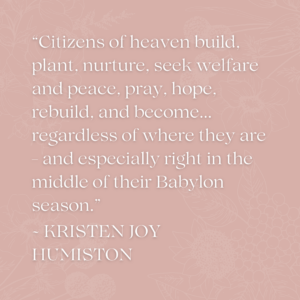
Citizens of heaven build, plant, nurture, seek welfare and peace, pray, hope, rebuild, and become…regardless of where they are – and especially right in the middle of their Babylon season.
In this way, we are formed between our now and our not yet – between the ordinary, painful, tension-filled ministry life we’re called to live and the glory we will one day experience fully with Him in heaven. Together, as it was always intended, we will finally, truly be “living above the world.”
Taking It Further:
If you’re in a “now and not yet” season, what feels too heavy to carry?
How might you notice God in this season with you?
What human(s) has He given you in life (at any time!) who could encourage you and walk with you in this season – even if you have to initiate the invitation for support?
If you like music, you might be blessed by THIS SONG by Aaron Williams.
(Oh, and if you want to listen in to that childhood song, Living Above the World, take a LISTEN HERE.)