
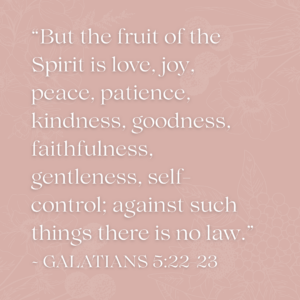
“But the fruit of the Spirit is love, joy, peace, patience, kindness, goodness, faithfulness, gentleness, self-control; against such things there is no law.”
Galatians 5:22-23
Fruit is an important theme in Scripture. It is used often to talk about God’s people being fruitful and multiplying, it is used to talk about the fruit of the land, and it is used to talk figuratively about character. What kind of fruit are people producing? What do their words and actions reveal about their hearts, about who or what they are serving?
More than once in Scripture, God says that we will know who people are by their fruit. Matthew 7:15-18 says, “Beware of false prophets, who come to you in sheep’s clothing but inwardly are ravenous wolves. You will recognize them by their fruits. Are grapes gathered from thornbushes, or figs from thistles? So, every healthy tree bears good fruit, but the diseased tree bears bad fruit. A healthy tree cannot bear bad fruit, nor can a diseased tree bear good fruit.” This should cause us to pause and evaluate our own little fruit farms – what kind of fruit am I seeing in my own life? Moreover, what kind of fruit should I be seeing? Also, as a parent, what kind of fruit am I seeing in my children’s lives? What does good fruit look like?
Thankfully, God has given us a roadmap! In Galatians 5, Paul outlines nine fruits of the Spirit. A fruit of the Spirit is just what it sounds like – something that is produced by the Holy Spirit. If the Holy Spirit has filled us, then there will be clear fruit that is produced by His work in our lives, that overflows out of our hearts and is visible to others around us.
On the other hand, if the Holy Spirit is not at work in us, or if we are not obeying His work in us, a very different kind of fruit will be evident – fruit of the world. These bad fruits are evident everywhere we look. They occur naturally as sinful people live for themselves, and are in direct contrast to the good fruits of the Spirit. They are what we produce naturally on our own, without the Spirit’s work in us.
Love vs. Hate
The first fruit is love. Love is truly selfless, focused on others. This fruit shows itself in how we talk to and about other people, in how we put their needs before our own, about how we give up what we want in order to help someone else. Love recognizes that every human being is a person of worth, made in God’s image, and therefore worthy of love. In contrast, the worldly fruit of hate is all about rejecting other people as “less than.” Hate finds fault with others and harbors malicious intent towards them. Hate spews forth vitriol and condemnation. Which fruit am I seeing flourish in my life? Which fruit am I nourishing? Do I surround myself with people and things that encourage love or hate?
Joy vs. Discontentment
The second fruit is joy. We often mistakenly think of joy as happiness, but joy is so much deeper than mere happiness. Joy is a deep delight and contentment in God. We find everything we need in Him and that delights us. We are content with what God has given and can be glad with what we have, with who we are in Him. In contrast, discontentment is a continuing lack of being satisfied. There is never enough, never exactly what we want, and ultimately, we don’t believe that God Himself is enough. If we don’t believe that God is enough or that He has given us all that we need, we will never be satisfied, and we will never know true joy. Am I truly content and joyful in the place where God has put me? Or am I always dissatisfied, looking for the next thing to make me feel better?
Peace vs. Division
Next is peace. This is a true harmony between individuals. This doesn’t mean that there is never conflict, but rather, we desire to reconcile and restore relationships. This is all rooted in the peace that comes from our restored relationship with God. Because God saved us and made us whole in Him, we can have a relationship together. That relationship is the foundation of all human relationships that we have, and the source of our inner peace. Conversely, the worldly fruit of division seeks to sow chaos and disorder. A fruit of division delights in driving wedges between people and breaking relationships apart. Do I seek to have healthy relationships and restore broken ones? Or do I harbor bitterness towards others, allowing broken relationships to fester and stay broken? Do I stir up strife and chaos in other relationships around me?
Patience vs. Quick-tempered
The fourth fruit is patience. A patient person is long-suffering, willing to endure hardships or wrongs without lashing out or seeking revenge. Additionally, patience says, “I trust God in the midst of this problem, and I will wait on Him.” However, someone who is quick-tempered says, “I need my pound of flesh now!” and immediately seeks what it wants, no matter the cost to others. Am I willing to endure whatever hardship I am facing and wait on God to show me the way through it? Or am I quick to lash out at others, to blame them, or to hurt those who have hurt me?
Kindness vs. Harshness
The fruit of kindness is so sweet and desirable. To treat another person kindly is to genuinely care about them, to consider what they need and desire it for them as well. It genuinely wants to help others without expecting anything in return, with no ulterior motives. On the other hand, harshness is sharp and thoughtless, caring nothing for what it does to another person. Harshness does not care what anyone else needs, and willingly hurts others if they get in the way of what I want. Am I truly seeking to help others in the way that they need, just because I care for them? Do I have a secret, selfish motive that is really about what I can get in return? Am I willing to hurt others if it serves my purposes?
Goodness vs. Wickedness
The fruit of goodness is being upright and standing for what is true. With goodness, I want to do what is right because it is what is right, because it is what honors God. I want to do good because I want to serve Him. A stark difference is wickedness – this worldly fruit is all about doing what is evil and dishonoring to God. Wickedness actually desires to harm others, looking for ways to tear down and hurt God’s creation, acting in open rebellion to Him and His ways. Am I living for what is good, right, and honorable? Or am I swayed by the evil things of this world?
Faithfulness vs. Untrustworthiness
The next fruit of faithfulness means I can be relied on and trusted. I will do what I have been called to do, and I will stay true to God and His Word, no matter what comes. On the contrary, untrustworthiness means I am unstable, wishy-washy, and cannot be trusted about anything. This is a person who will change with the wind and not stay on course. When people look at me, do they see someone they can trust, who they know stays true to God no matter what? Or do they see someone who changes with the tide and can’t be trusted?
Gentleness vs. Arrogance
Next is gentleness – this fruit that can be called meekness or humility. This fruit is modeled after Jesus’ own heart, as seen in Matthew 11:29 when He says, “…for I am gentle and lowly in heart…” Jesus Himself was gentle and we seek to be like Him. There is a tenderness in this fruit, like a mother caring for a child. Gentleness can also be described as strength under control – it is not weakness, but rather, having strength and controlling it in order to care for someone else. A contrast to this fruit is arrogance. There is no humility, no softening oneself in order to care for others; rather, this worldly fruit seeks to assert my greatness and strength over and above others. Is my life characterized by treating others with humility and respect, with tender care? Or do I eagerly assert myself and my desires above others?
Self-control vs. Weakness of Will
The last fruit is self-control. This fruit is shown over time, as we consistently choose to say no to temptations. Self-control means not giving in to the things that we crave and sound so good, but we know are sinful. It means not giving in when others are pressuring us or ridiculing us. In contrast, a weakness of will shows that we love the world more than we love God, because we give in when the temptation is strong enough. Am I consistently saying “no” to temptation, or “yes”? Which do I do most often?
After looking at this list, I need to evaluate – which fruit am I seeing in my life? The fruit of the Spirit, or the fruit of the world? Also, as I evaluate for myself, I look at my children. What fruits am I seeing in their lives? I desperately want them to be filled with the fruit of the Spirit, but is that what they are seeing modeled in my own life?
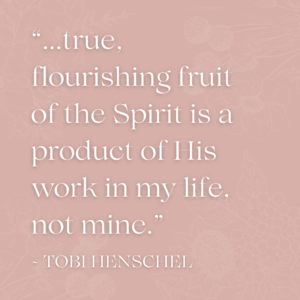
As I perform this heart-check, I need to remember: these fruits of the Spirit are not things that we can produce in our lives by just gritting our teeth and trying harder. I can’t say, “Oooh, I need to be more patient,” and just try harder. Certainly, I can work on these characteristics. But true, flourishing fruit of the Spirit is a product of His work in my life, not mine. He works in me and these fruits become stronger and more apparent. I need to let Him do His work in me.
How? In the same way a fruit tree flourishes – with the right nourishment. I need to be grounding myself in the Word, feeding myself a steady diet of truth. I need to be satisfying my thirst by coming to God in prayer, bringing everything to Him, and praising His name. I also need to be carefully pruning away the rotten fruit – confessing my sin to God and allowing Him to heal me. As I do these things, the Spirit has room to do His work in me and to fill me with His fruit. And as I model these things to my children, they have the same opportunities to allow His fruit to flourish in their lives as well.
Taking It Further:
Which fruit struck you as one that you would like more of in your life? Pray and ask the Holy Spirit to produce that fruit in your life, and ready your heart for His work.