

Mistakes are how you learn. A teacher I once worked with repeated this phrase often to our students. Most of the time, she shared it to comfort students who were feeling overwhelmed or frustrated with a task they just couldn’t get right.
In those situations, I really liked that phrase and began to repeat it, too, as an encouraging word because mistakes happen all the time, of course, in a classroom where you’re supposed to be learning.
But a part of me really doesn’t like that phrase because I don’t like that making mistakes in order to learn means pain, struggle, and sometimes sorrow and sadness. Some mistakes aren’t as small as adding or subtracting a math problem incorrectly and have bigger consequences than getting a red check mark on the page.
Whether we like it or not, there is pain in learning and growth. It’s the way God’s designed His world, so we need to embrace that concept and learn to accept it, especially as it relates to growth in our own lives and the lives of our children.
As my girls have entered the young adult/older teen stage, I have wished many times that I could go back to the days of their getting in trouble for sneaking a cookie when they were told not to or for saying an unkind word to their sibling. The bigger the decisions, the bigger the mistakes, the bigger the pain and consequences.
Because of this, I have found myself many times wanting to prevent that pain and swoop in and stop my children from making those mistakes. But without the pain, growth will be stilted.
I am transported back to my fifth-grade science classroom. I can picture the large plate glass
windows with the long counter underneath, a whole line of baggies in a row, each cradling a white or purple bean seed in a wet, brown paper towel. It’s a classic science lesson in which we can observe the process of growth. As we budding scientists marked our daily observations, we did not have much to write until about a week or so later when one or two of the seeds had absorbed enough moisture from the paper towel and the shell of the seed had begun to crack.
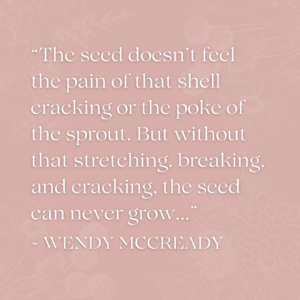
The seed doesn’t feel the pain of that shell cracking or the poke of the sprout. But without that stretching, breaking, and cracking, the seed can never grow into a plant with a stem and leaves that produce fruit.
If I try to stop growth in my children as they begin to make choices on their own with increasing independence and less and less guidance and influence from me (as is right), then I will only be increasing their pain and stunting their growth.
But what if I am watching them make a horrible mistake that is going to cause pain to them and possibly others?! Can’t I step in and stop that?
Well…yes, I can, but…should I always?
I will never forget when I was a young mother eager to do this parenting thing right. The Spirit gave me insight to God’s relationship with His people Israel.
The Israelites were parented by the perfect Father God, and yet they rebelled left, right, and center. Repeatedly. I knew, then, that no matter how perfectly I parented, I couldn’t keep my children from making mistakes, from rebelling against me at times. Like God fathers me, I would need to go through the process of loving, disciplining, guiding, and then letting my children go out from me to learn for themselves how to relate to God and others in the world. After all, I have made my share of mistakes, too, and, yes, they helped me learn things I never would have otherwise.
The pain and fear of sending out our children, from the first day of kindergarten to marriage and beyond is a part of the learning process for them and for me. I can’t interfere with that just because I’m too afraid to entrust my child to God and release control that was never really mine in the first place.
The Father understands what it means to release a child to the pain and suffering required for growth. No, His Son did not have to learn and be tempted in the same ways we do since Jesus was perfect and would do His Father’s will perfectly. But following that perfect will meant that Jesus would face the greatest suffering ever by bearing the weight of the sin of the world as well as the excruciating pain and grief of separation from His Father.
The author of Hebrews teaches us that “although he [Jesus] was a son, he learned obedience through what he suffered. And being made perfect, he became the source of eternal salvation to all who obey him” (Hebrews 5:8-9). It’s hard for us to grasp how or why suffering was required for a perfect Savior to learn, but what it does teach us is that submitting to the growth process is necessary.
If it’s necessary for Christ, then we surely need no less. Nor do our children.
So…how do we do it? How do we walk through those excruciating times when our children are learning from their mistakes, and we are feeling the pain and suffering with them, longing to stop it for their sake and for ours? How do we find hope in the waiting and hurting?
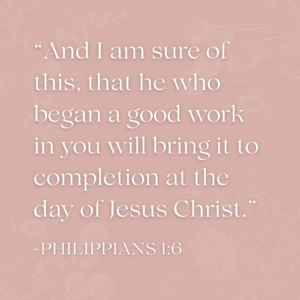
For years I’ve returned to the promise of Philippians 1:6 to encourage myself in my own battles with sin. Paul tells the Philippians “I am sure of this, that he who began a good work in you will bring it to completion at the day of Jesus Christ.” This is the promise for all of those who are His. Now it encourages me as I watch my children growing up.
When I find them veering off the path of life, whether for a short or long detour, I can be assured that the pain and suffering are a part of the journey. They are part of the long-range vision plan of God who sees things from the beginning to the end. He knows that the mistakes they make will be used for their good and His glory and that He will complete the work He’s started in them to make them into the citizens of heaven He’s called them to be. He’s doing the same with me.
My job is to trust Him, to rest in Him, even in the midst of the anxiety over what decisions they might be making. I need to resist the urge to try to control or to stop the consequences. I must let the mistakes do the work of learning and growth, and pray that those seeds planted grow up into bearing fruit for His eternal kingdom.
Taking It Further:
How can having an eternal vision of parenting encourage you as you watch your children struggle in their walks with God? What step of faith do you need to take today to further entrust your children to God?