
Lately I’ve been considering what it means to be in a “desert place.” This is typical Christian terminology that I’m sure most of us are familiar with. If someone says that she is in a desert place, we all have some concept of what that means. We’ve all been there at one time or another, and there is some community understanding of what that person might be experiencing.
As I was thinking about this, I had the thought that, although I know what a desert is and I can easily picture it, I have never actually visited a desert. If you ask me about my experience in an actual desert area, I do not have any. My impression of what a desert is like might have nothing to do with the reality of being there.
What I can do is tell you what drought looks like in the rural area where I live. This I have lived through, and I can describe it in detail, both what it does to the land and how it impacts the people who are experiencing it.
Drought creeps up slowly. You don’t just wake up one day and think, “Wow, looks like we are going to have a drought today!” It is much more insidious than that. There might be a few days without rain, and that turns into a few weeks and then several weeks. Drought takes time. It is not always noticeable because not everything is impacted by the lack of moisture at the same rate.
The water in the ditches and creeks starts to drop. That’s really not noticeable unless you are looking for it. The gravel roads start to roil with dust with every vehicle that passes, and one day you notice that the dust has coated the trees and grass in a grey cloak, muting their usual vibrant shades of green. Everything looks as if it has lost some of its life as the dusty days continue.
Slowly even lovingly tended and cultivated ground turns to cement, and wide cracks appear. The surface becomes so hard that even when a gentle passing shower arrives with a sliver of relief, it is impenetrable. I’ve seen more than one shovel break trying to dig into this dry earth.
The grass turns brown and crispy underfoot, and carefully tended flowers and vegetables only survive if they are watered from the tap. Fields of corn curl in upon themselves, conserving any moisture they have left. Whipping, it is called. I always know how badly we need rain when I see the whipped corn leaves.
The creeks continue to drop, and any standing water has long ago dried up. Birds grow listless and begin to pant. It seems as if the whole world is waiting for rain.
This is the drought that I know. It may be different from your own experience, but I know you can recognize your own signs of drought in my story. I also suspect that, like me, you can see an analogy in your own life that easily parallels the drought that occurs in our physical surroundings.
Drought. Spiritual dryness. It’s not about being lost in the wilderness, but just being sapped of all energy, all nourishment that is needed to thrive. Spiritual drought doesn’t come on suddenly either, does it? It creeps up, hidden by stress, exhaustion, and pushing ourselves past our limits. It builds and builds, and we don’t even notice it until one day it is just there.
It becomes hard to pray. We know God is there, but He seems distant. Spending time in Scripture becomes difficult because we read but don’t comprehend. We know we need to spend more time in relationship with Jesus, but we are gripped with an inertia that won’t let go.
One by one, more areas of our lives are impacted as we dry up, wilt, and then fold in on ourselves like crumpled tissue paper. Once our spiritual drought has taken hold, like the dry ground, we start to show outward cracks. Our inner drought makes it even harder to handle the stress and anxiety of everyday life, and before we know it, this begins to impact our interactions with our family and friends.
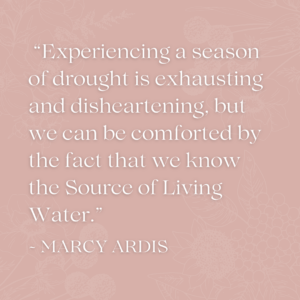
In the story of the woman at the well, we see Jesus describing Himself as the source of Living Water. In John 4:10 He tells her, “If you knew the gift of God, and who it is that is saying to you, ‘Give me a drink,’ you would have asked him, and he would have given you living water.” A little further along, in verse 14, He continues to explain by saying, “Whoever drinks of the water that I will give him will never be thirsty again. The water that I will give him will become in him a spring of water welling up to eternal life.” Experiencing a season of drought is exhausting and disheartening, but we can be comforted by the fact that we know the Source of Living
Water. We know where to go to begin to flourish once again.
We can do a variety of things to combat drought in our lives:
Pray anyway. Even when we don’t know what to say and don’t have the energy to say it if we did, we can still sit in God’s presence, lifting our lives up to Him.
Read the Bible. This might look like picking up your Bible or it could mean using an app, but either way, it allows God’s Word to pour over us and penetrate into us as Living Water. His words pour into the hard cracks and begin to nourish us.
Ask God to bring renewal. Psalm 23:2-3a says, “He makes me lie down in green pastures. He leads me beside still waters. He restores my soul.” God is faithful, and He will restore what we have lost in our season of drought.
Take a break from social media. The internet brings the world into our homes. It brings good things, like the ability to connect with family and friends, but it also brings discord and violence. It brings voices of anger and hate. We can purposefully choose to take a step back, not to ignore what is happening in the world around us, but to take the space we need to care for ourselves.
Get out in nature. There is no better place to see God than in the midst of His creation.
We need to look for His glory in the world around us. There is always beauty, even in the midst of a drought!
Do what makes you happy. Read a book, cook a special meal, have coffee with your partner or a close friend, draw, paint, write, sing, listen to a podcast. Each of us has something that calms our soul and allows our body to begin to relax. Can you remember what you used to love to do?
Give yourself grace. God our Father loves us deeply. He knows when we are struggling, and He loves us as we are. Can we do the same for ourselves?
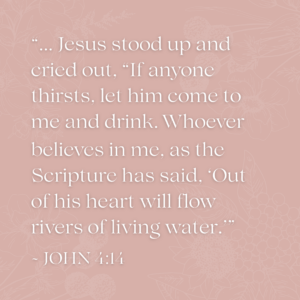
The drought always comes to an end. The skies open up and rain pours down, bringing new life where we think nothing will ever grow again. In John 7:37b-38, Jesus made a promise that we can all cling to as we look for renewal. He said, “If anyone thirsts, let him come to me and drink. Whoever believes in me, as the Scripture has said, ‘Out of his heart will flow rivers of living water.’”
If you are in a season of drought in your own life, cling to these verses. God is merciful, and you will be renewed. You will bloom again.
Taking it further:
Can you share a practice or verse that you find helpful when you are experiencing a season of drought in your life?
These are such great practical tips, Marcy, when feeling dry spiritually. Thank you for the reminder of the HOPE of God’s renewal.